
Your resume is often the first and sometimes only chance you get to make an impression. For many people, that reality creates pressure, confusion, and a lot of second-guessing. I’ve helped friends tweak resumes after months of silence, watched family members get rejected despite strong experience, and reviewed countless resumes that weren’t “bad” but quietly worked against their owners.
This guide is for job seekers who want honest, practical advice. Whether you’re a recent graduate, a career changer, returning to work after a break, or someone who’s been applying without results, these are the resume mistakes that consistently hold people back. Some are obvious. Others are subtle but costly. And most are fixable once you know what to look for.
I’ll walk through the most common resume mistakes, explain why they matter in real hiring situations, and share lessons I’ve seen play out again and again. If you’ve ever wondered, “Why am I not getting interviews?”; this is a good place to start.
What a Resume Is Actually Meant to Do
One of the biggest misunderstandings I see is people treating a resume like a life history document. In real hiring situations, that’s not how it’s used.
A resume has one main job: to earn you an interview. It’s not there to tell your entire story, defend every career move, or prove you’re a good person. Recruiters usually skim resumes quickly, often under a minute, looking for clear signals that you match what they need.
From what I’ve seen, resumes fail not because the candidate lacks experience, but because the resume doesn’t make that experience easy to understand or relevant to the role. Many mistakes come from trying to include too much, explain too much, or impress in the wrong way.
Keeping this purpose in mind makes the rest of the advice much easier to apply.
Using One Resume for Every Job
This is probably the most common and damaging mistake.
People often send the same resume to dozens of jobs, hoping something sticks. I’ve watched a friend do this for months with no responses, then suddenly start getting interviews after tailoring just the top third of the resume.

Why this hurts you:
- Job descriptions vary more than people realize
- Employers scan for specific skills and keywords
- A generic resume feels unfocused and forgettable
You don’t need to rewrite everything each time, but you do need to adjust:
- Your summary or headline
- The order of bullet points
- The language used to match the job posting
People often don’t realize how much small wording changes can affect whether a resume passes initial screening.
Writing a Vague or Weak Summary
A resume summary can help or hurt you quickly.
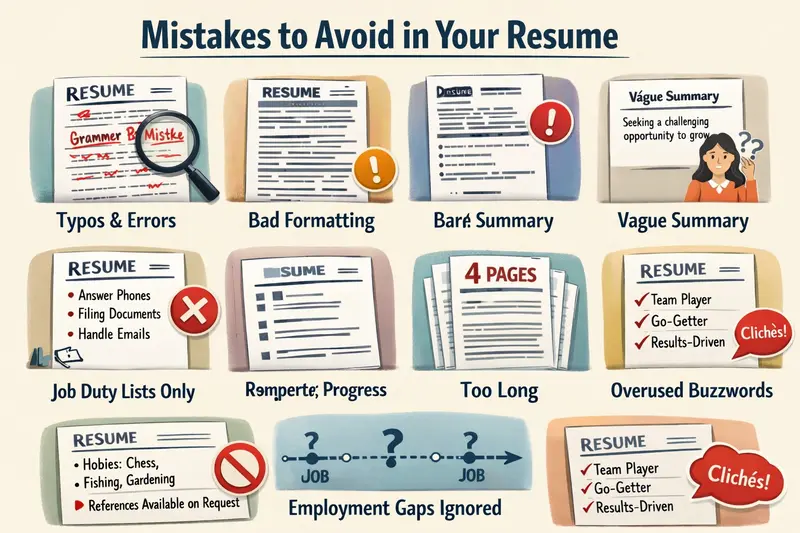
A weak summary looks like this:
“Hardworking professional seeking an opportunity to grow and contribute to a dynamic organization.”
This tells the employer nothing specific and sounds like hundreds of other resumes.
A strong summary briefly answers:
- Who you are professionally
- What you specialize in
- What kind of role you’re targeting
In real situations, I’ve seen summaries make the difference between a recruiter reading further or skipping the rest. If you can’t clearly explain your value in two or three sentences, the rest of your resume may not get attention.
Listing Job Duties Instead of Achievements
This mistake shows up everywhere.
Many resumes simply list responsibilities:
- Answered phones
- Managed emails
- Helped customers
The problem is that job duties don’t show impact. They don’t explain how well you did the job or what changed because of your work.
Whenever possible, focus on:
- Results
- Improvements
- Outcomes
- Scope of responsibility
For example:
- Resolved customer issues with a high satisfaction rate
- Managed scheduling for a team of 12
- Reduced processing errors through improved tracking
I’ve watched resumes improve overnight just by reframing duties into outcomes. Even small achievements count.
Including Too Much Irrelevant Information
More is not always better.
People often include:
- Every job they’ve ever had
- Outdated skills
- Personal details that don’t belong on a resume
- Hobbies that aren’t relevant
This creates clutter and makes it harder for employers to see what actually matters.
In real hiring reviews, irrelevant details can distract or raise unnecessary questions. For example, listing unrelated jobs from 15 years ago may make your resume feel outdated rather than experienced.
As a general rule:
- Focus on the last 10–15 years
- Prioritize relevance over completeness
- Cut anything that doesn’t support the role you want now
Poor Formatting and Hard-to-Read Layouts
You could have great experience and still get rejected because your resume is difficult to read.
Common formatting problems include:
- Tiny fonts
- Long paragraphs
- Overcrowded pages
- Fancy fonts or graphics that don’t scan well
- Inconsistent spacing
From what I’ve seen, clean and simple wins almost every time. Recruiters want clarity, not design experiments.
Practical formatting tips:
- Use standard fonts
- Keep bullet points short
- Use clear section headings
- Leave white space so the page can breathe
If a recruiter has to work to understand your resume, they usually won’t.
Making It Too Long or Too Short
Length matters more than people think.
A resume that’s too long can feel unfocused. One that’s too short may feel incomplete.
General guidance:
- Early career: one page is often enough
- Mid-career: one to two pages
- Senior roles: two pages is usually acceptable
I’ve seen people cut a three-page resume down to two and start getting interviews again. I’ve also seen one-page resumes that felt empty because important experience was missing.
The right length is the one that clearly tells your story without filler.
Typos, Grammar Errors, and Inconsistencies
This sounds basic, but it’s still a major issue.
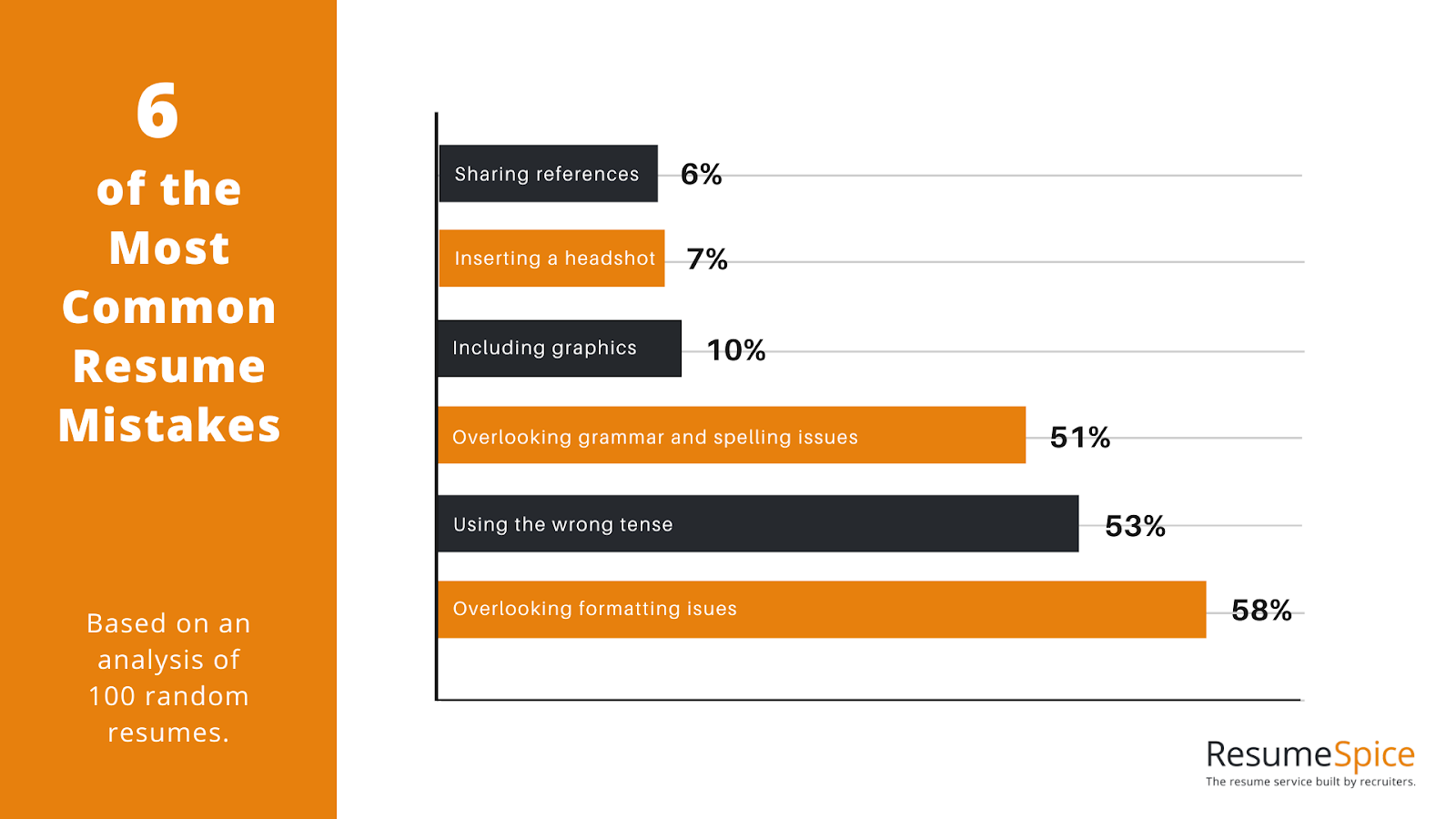
Even one typo can raise doubts about attention to detail, especially for roles that require communication, accuracy, or professionalism.
Common issues include:
- Misspelled job titles
- Inconsistent dates
- Mixed verb tenses
- Formatting errors
I’ve personally watched a hiring manager dismiss a resume because of repeated small mistakes—not because the candidate wasn’t capable, but because it suggested carelessness.
Always proofread. Then have someone else review it. Fresh eyes catch what you miss.
Not Explaining Employment Gaps at All
Employment gaps are common, especially now. The mistake isn’t having a gap—it’s ignoring it completely.
When gaps aren’t addressed, employers may assume the worst or feel uncertain.
You don’t need long explanations, but you can:
- Briefly note caregiving, education, or health reasons
- Highlight freelance or volunteer work
- Focus on skills maintained during that time
I’ve seen resumes improve simply by adding a short, honest line that provides context without over-explaining.
Overusing Buzzwords and Clichés
Terms like “team player,” “go-getter,” and “results-driven” appear on countless resumes.
The problem is not that they’re wrong—it’s that they’re vague.
Employers want evidence, not labels.
Instead of saying:
- “Strong leadership skills”
Show it:
- Led onboarding for new hires and mentored junior staff
Concrete examples always land better than buzzwords.
Lying or Stretching the Truth
This is one mistake that can seriously backfire.
Some people exaggerate titles, dates, or skills thinking it helps them get noticed. In real hiring processes, these details are often verified later.
From what I’ve seen, even small inconsistencies can lead to lost offers or damaged trust.
You don’t need to lie to look qualified. You need to present your experience clearly and confidently.
Realistic Expectations: What Fixing These Mistakes Can (and Can’t) Do
Fixing resume mistakes can dramatically improve your chances of getting interviews, but it’s not a guarantee.
A strong resume:
- Improves response rates
- Helps you get past screening systems
- Makes recruiters understand you faster
It won’t:
- Instantly land a job
- Overcome major skill gaps
- Replace networking and preparation
Think of your resume as a tool. When it works well, everything else becomes easier.
Practical Resume Tips I’ve Seen Actually Work
Based on real situations I’ve watched play out:
- Start with the job description and mirror key language naturally
- Lead with your strongest, most relevant experience
- Keep bullet points focused on outcomes
- Update your resume regularly, not only when job hunting
- Save versions tailored to different role types
One friend kept updating the same resume for years. Once they started treating it as a living document, the process became far less stressful.
Frequently Asked Questions
How many mistakes on a resume are too many?
There’s no exact number, but patterns matter. One small typo might be overlooked. Multiple errors suggest a lack of care. Employers often see resumes as a sample of your work quality, especially for office or professional roles. If mistakes appear throughout, it raises concerns about how you’ll handle tasks on the job. This is why proofreading matters so much. Even strong candidates can get filtered out because of avoidable errors.
Is it okay to use a resume template?
Yes, as long as it’s clean, readable, and compatible with applicant tracking systems. Simple templates often work better than highly designed ones. The mistake people make is relying on the template to do the work. Content still matters more than appearance. Use templates as a structure, not a shortcut.
Should I remove old jobs from my resume?
In many cases, yes. Jobs from over 10–15 years ago that aren’t relevant can be removed or summarized. Keeping everything can make your resume feel dated. Focus on experience that supports your current goals. Older roles can still be useful if they show leadership or transferable skills, but they don’t need full detail.
Do employment gaps automatically hurt my chances?
Not necessarily. Many employers understand gaps, especially when explained briefly and honestly. The mistake is leaving them unexplained. Providing context shows transparency and confidence. Focus on what you bring now rather than trying to hide the past.
How often should I update my resume?
Ideally, every few months or after major accomplishments. Updating regularly makes job searching easier when opportunities come up unexpectedly. Waiting until you’re desperate to apply often leads to rushed resumes and missed details.
A Resume Is a Skill You Can Improve……….
Resume writing isn’t intuitive, and most people were never taught how to do it well. That’s why so many capable candidates struggle quietly.
If your resume hasn’t been getting responses, don’t assume it’s a reflection of your worth or ability. In real situations, I’ve seen small changes lead to big improvements. Avoiding the mistakes in this guide won’t guarantee a job, but it will give you a fairer shot.
Treat your resume as a living document, not a one-time task. With thoughtful adjustments and honest presentation, it can start working for you instead of against you.